
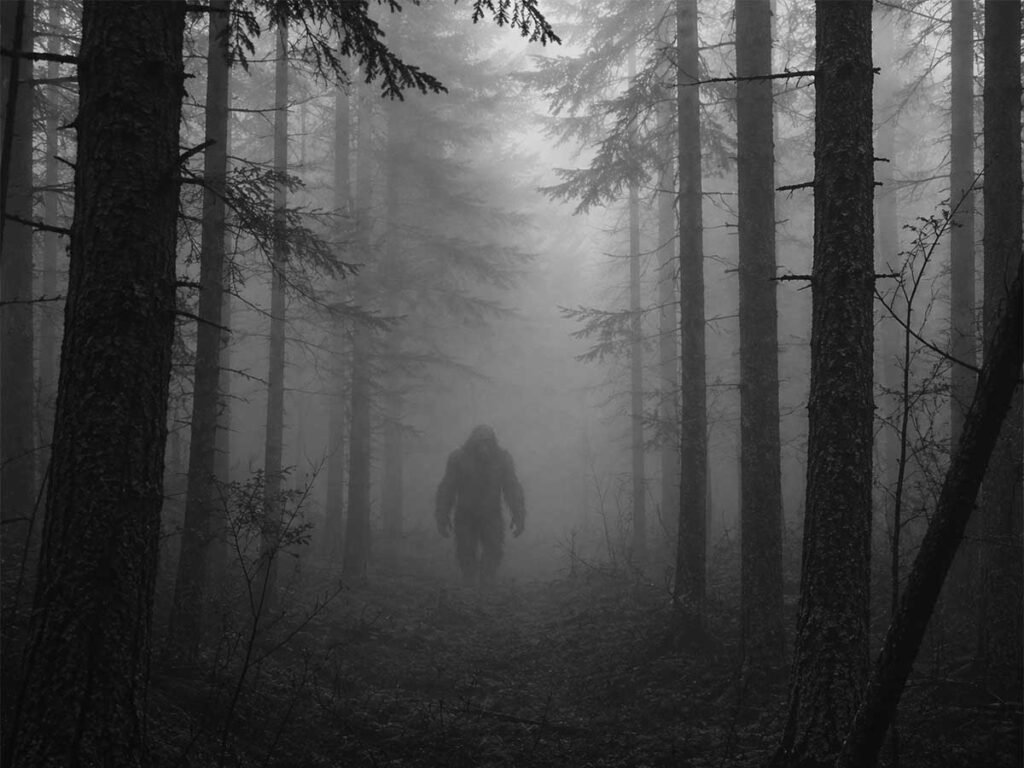
The History of Bigfoot and Bigfoot-Like Creatures Around the World
For as long as people have lived beside deep forests, high mountains and unexplored wilderness, they have told stories about beings that seem to exist somewhere between humans and animals. They are described as tall, powerful and covered in hair. They walk upright, leave enormous footprints and usually disappear before anyone can obtain clear evidence.
In North America, the creature is called Bigfoot or Sasquatch. In the Himalayas, it is the Yeti. Australia has the Yowie, China has the Yeren, Central Asia has the Almas and Sumatra has the Orang Pendek. Although these beings are often grouped together today, they did not all begin as versions of the same story. Each arose within a different culture, landscape and historical period.
So where did the Bigfoot story truly begin—and are people seeing these creatures more often today?
Before Bigfoot: The Ancient Wild Person
Bigfoot’s family tree reaches much farther back than the familiar image of a towering ape walking through the forests of the Pacific Northwest. Stories about wild, hair-covered people appear in some of humanity’s oldest surviving traditions.
The ancient Mesopotamian Epic of Gilgamesh includes Enkidu, a powerful wild man who lives among animals before entering human society. Ancient Greek and Roman traditions contained satyrs, fauns and other beings that combined human and animal characteristics. Medieval European art and literature featured the “woodwose,” or wild man of the woods—a hairy humanlike figure who lived beyond civilization.
These figures were not necessarily eyewitness descriptions of unknown animals. They frequently represented wilderness, danger, freedom or humanity without the restraints of society. Their importance is that they demonstrate how old and widespread the idea of a personlike being outside civilization really is.
Similar traditions developed in Asia, Australia and North America. It would be misleading to claim that every traditional forest being was literally Bigfoot. Many were spiritual beings, ancestors, cautionary figures or characters within complex religious traditions. Modern writers have sometimes removed these stories from their original meanings and recast them as cryptid reports.
Indigenous Traditions of North America
Long before English speakers used the name Bigfoot, Indigenous communities in western North America told stories involving powerful beings associated with forests, mountains and remote places.
The word Sasquatch is generally traced to Sasq’ets, a name associated with the Sts’ailes people of British Columbia and the Halq’emeylem language. In 1929, teacher and government agent J. W. Burns published accounts about British Columbia’s “hairy giants.” Burns adapted the Indigenous term into the English word “Sasquatch.”
This does not mean every Indigenous tradition describes the modern ape-like creature promoted in television programs. The identities and meanings of these beings differ among nations. Some are physical forest people; others possess supernatural qualities. Indigenous traditions deserve to be presented in their own cultural contexts rather than treated simply as proof for a modern cryptid.
Nevertheless, the 1929 publication helped introduce “Sasquatch” to a wider English-speaking audience nearly thirty years before the name Bigfoot became famous.
The Birth of the Name “Bigfoot”
The modern American Bigfoot story can be traced directly to Northern California in 1958.
Construction crews were building a logging road near Bluff Creek in Humboldt County when enormous humanlike tracks began appearing around their equipment. Bulldozer operator Jerry Crew made a plaster cast of one print and brought it to the Humboldt Times. On October 6, 1958, the newspaper published a photograph of Crew holding the cast.
Reporter Andrew Genzoli used the workers’ nickname for whatever had made the tracks: “Bigfoot.” The story was distributed beyond Northern California, and the name quickly entered popular culture.
Years later, relatives of road contractor Ray Wallace claimed that Wallace had created some of the Bluff Creek tracks with carved wooden feet. Wooden track-making devices were reportedly found among his belongings after his death in 2002. This strongly suggests that at least some of the footprints connected with the original publicity were hoaxes.
But Wallace did not invent the older Sasquatch traditions, nor did his family’s disclosure end the mystery. By then, “Bigfoot” had become the popular name for decades of older reports, Indigenous traditions and new eyewitness claims from across North America.
The Film That Defined Bigfoot
On October 20, 1967, Roger Patterson and Bob Gimlin were riding near Bluff Creek when they filmed a large, hair-covered figure walking across a sandy creek bed. The short sequence—usually called the Patterson–Gimlin film—created the image most people still associate with Bigfoot.
The figure walks away from the camera, turns its upper body to look back and continues into the trees. Supporters argue that its stride, body proportions and apparent muscles would have been difficult to reproduce with a costume in 1967. Skeptics believe it shows a person in an ape suit and point to conflicting stories surrounding the production.
No original creature, costume or conclusive physical evidence has resolved the argument. More than half a century later, the film remains the most famous and most disputed piece of Bigfoot evidence.
Bigfoot-Like Creatures Around the World
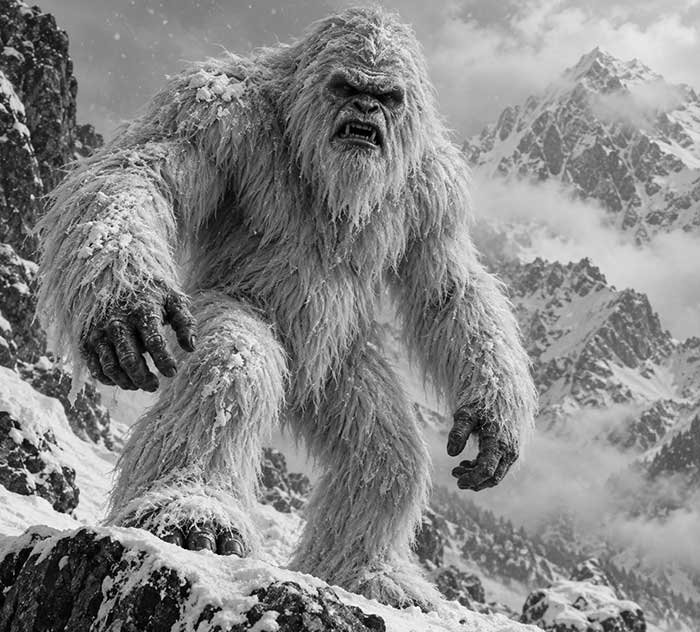
The Yeti — Himalayas
The Yeti is associated with the Himalayan regions of Nepal, Tibet, Bhutan and northern India. Local traditions are older and more complicated than the Western image of a white “Abominable Snowman.” Reports often describe dark, reddish or brown hair rather than white fur.
Western fascination grew during nineteenth- and twentieth-century expeditions. In 1921, journalist Henry Newman translated a phrase connected with tracks found during a British Everest expedition as “Abominable Snowman,” a dramatic name that became internationally famous.
Mountaineer Eric Shipton photographed an enormous footprint in snow near Everest in 1951. The photograph helped launch a wave of Yeti expeditions. Hair, bone and skin samples promoted as Yeti remains have subsequently been identified as bears, dogs and other known animals. Bears—particularly Himalayan brown and black bears—remain a leading explanation for many encounters.
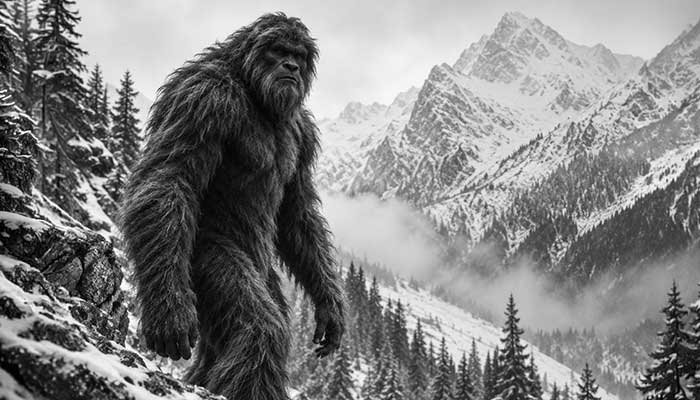
The Almas — Central Asia
Stories of the Almas or Almasty occur in Mongolia, the Caucasus and other parts of Central Asia. Unlike the enormous North American Bigfoot, the Almas is frequently described as more humanlike: shorter, covered with reddish-brown hair and possessing a sloping forehead and powerful body.
Some cryptozoologists have suggested that Almas reports preserve memories of surviving archaic humans. No bones, DNA or living specimen has supported that theory. The accounts remain a mixture of regional folklore, travelers’ stories and modern cryptozoological interpretation.
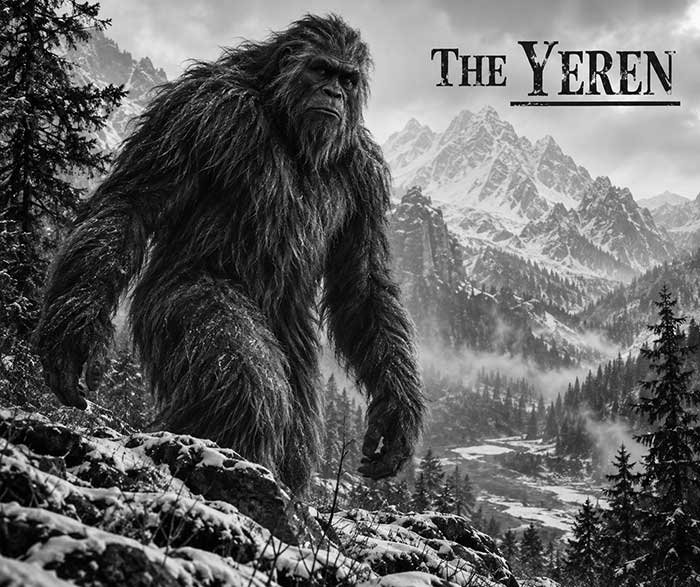
The Yeren — China
China’s Yeren, meaning “wild man,” is most strongly associated with the forested Shennongjia region of Hubei Province. Reported descriptions resemble both Bigfoot and older wild-person traditions: an upright figure with reddish or brown hair, long arms and a humanlike face.
Organized searches occurred during the twentieth century, particularly after reports increased in the 1970s. Alleged hair and footprints were collected, but none produced accepted evidence of an unknown primate. Misidentified bears, monkeys and folklore have all been proposed as explanations.
The Yowie — Australia
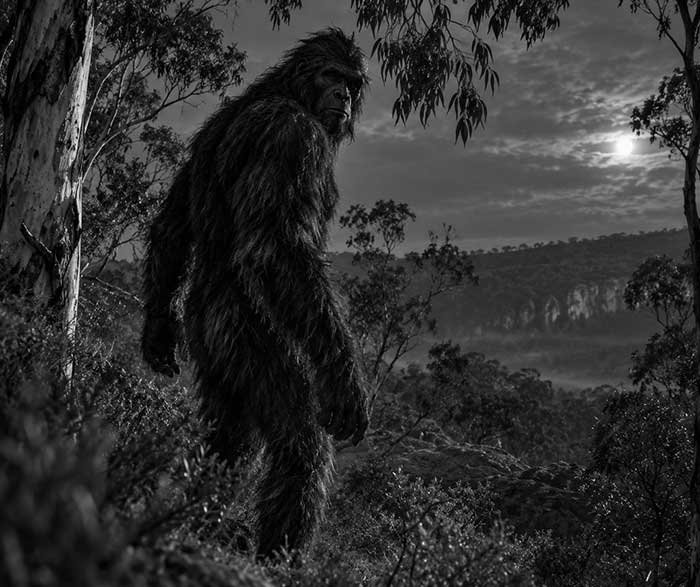
The Yowie is usually described as a tall, hair-covered biped living in the Australian bush. European settler newspapers began printing “wild man” reports during the nineteenth century. Later writers connected these accounts with Aboriginal traditions, although the original beings and stories vary greatly among communities.
Modern Yowie reports commonly come from Queensland and New South Wales. Witnesses describe heavy footsteps, strong odors, howls and large figures crossing roads. As with Bigfoot, no verified body or biological sample has been recovered.
Orang Pendek — Sumatra
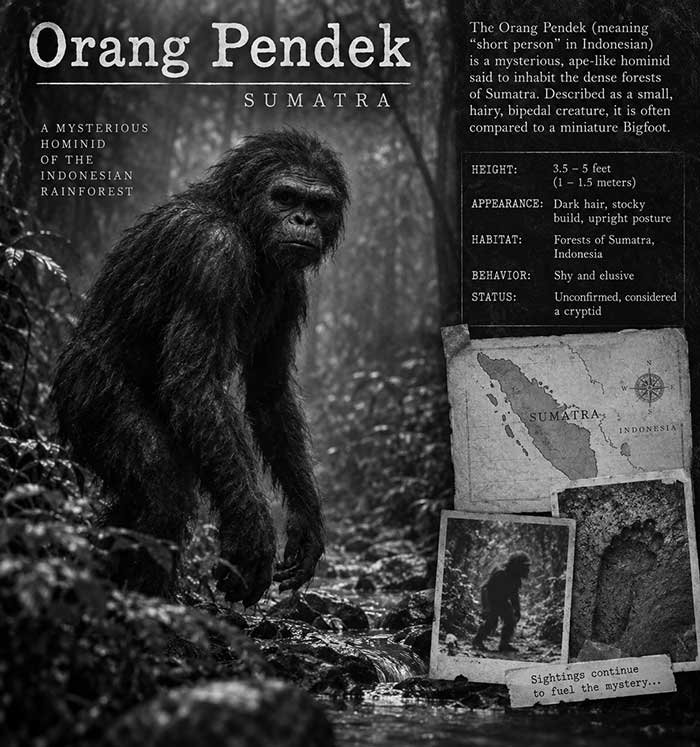
The Orang Pendek, whose name means “short person,” differs from the towering Bigfoot. It is usually described as three to five feet tall, powerfully built and covered in short hair. Reports concentrate around the forests of Sumatra, particularly Kerinci Seblat National Park.
Indigenous residents, colonial-era travelers and modern researchers have all reported encounters. Because Sumatra contains known primates and still supports extensive forest, some investigators consider the Orang Pendek one of the more biologically plausible mystery primates. Yet alleged tracks and hair remain inconclusive, and no specimen has been verified.
Other Regional Names
Bigfoot-like stories are also associated with the Mapinguari in the Amazon, the Hibagon in Japan, the Mande Barung in northeastern India and various “wild men” in Russia and Southeast Asia. These creatures should not automatically be treated as one species. Their reported sizes, behaviors and supernatural characteristics differ considerably.
The resemblance among them may reflect similar human responses to wilderness. A large bear standing upright, a known primate seen briefly, an unfamiliar person, a hoax or a frightening sound in the darkness can all become the beginning of a wild-person story.
Why Have We Never Found a Body?
Thousands of sightings have been claimed, but mainstream zoology does not recognize Bigfoot, the Yeti or any comparable creature as an established species.
The central problem is not simply the absence of a perfect photograph. To establish a large breeding population, scientists would expect physical evidence such as bones, teeth, tissue, scat or DNA that can be independently tested. Hair samples submitted as Bigfoot or Yeti evidence have repeatedly been identified as known animals or humans.
In a major 2014 genetic study, researchers examined 30 hair samples associated with anomalous primates. The usable samples matched known creatures—including bears, wolves, cattle, raccoons, deer, porcupines and humans—rather than an unknown ape.
Common explanations for sightings include:
- Black bears standing or walking briefly on two legs
- People seen through trees, fog or darkness
- Tree stumps, shadows and other examples of mistaken perception
- Known primates in parts of Asia
- Deliberate hoaxes and costumes
- Footprints altered by melting, erosion or overlapping animal tracks
- Memories that change as witnesses repeatedly retell an experience
None of these explanations proves that every witness is lying. A person may sincerely report something they cannot identify without the object being an undiscovered primate.
Are There More Sightings Today—or Fewer?
The honest answer is that no reliable worldwide count exists.
The Bigfoot Field Researchers Organization, founded in 1995, maintains the largest widely used public collection of North American reports. Its database contains reports from many decades, but it cannot be used like an official wildlife census. People may wait years before submitting an experience; investigators do not publish every submission; standards change; and recent cases may not appear until an investigation is completed.
Available compilations suggest that publicly cataloged North American reports rose sharply from the late twentieth century into the early 2000s, when internet reporting made it easier for witnesses to find researchers. Some analyses of the public BFRO data show fewer incidents dated after approximately 2020. That apparent decline must be treated cautiously because of reporting delays and incomplete publication.
Around the world, modern claims continue to appear every year, but there is no solid evidence that the underlying rate of sightings is increasing. What has unquestionably increased is their visibility. A roadside figure that once became a local newspaper story can now be recorded, posted and viewed by millions within hours.
Smartphones have not produced the decisive evidence many expected. Instead, they have generated a flood of distant videos, trail-camera images, audio recordings and internet hoaxes. Cameras also have limitations: surprising encounters happen quickly, frequently in poor light and at considerable distance. Digital manipulation and artificial intelligence now make spectacular images easier to fabricate, further complicating evaluation.
Therefore, the fairest conclusion is:
- Reports still occur regularly.
- Online attention can make sightings appear more common.
- Some public databases show a recent decline, not a clear increase.
- Incomplete and delayed reporting prevents a dependable comparison.
- No recent report has produced scientifically accepted proof of an unknown humanlike primate.
Why the Legend Refuses to Disappear
Bigfoot survives because it occupies the uncertain border between the familiar and the unknown. It resembles a human but remains outside human society. It appears close enough to leave tracks yet far enough away to escape confirmation. It also offers the appealing possibility that the modern world has not explored everything.
The creature changes with its surroundings. In the Himalayas, it belongs to snow-covered mountains. In Sumatra, it hides in tropical forest. In Australia, it crosses isolated bush roads. In Ohio, the Grassman is connected with wooded hills, abandoned mines and lakes. Each landscape gives the mystery a local identity.
For believers, the accumulated testimony suggests a real animal that science has overlooked. For skeptics, Bigfoot demonstrates how folklore, misidentification and popular culture reinforce one another. Between those positions are thousands of witnesses who are certain they encountered something but cannot prove what it was.
A Worldwide Mystery Without a Final Answer
The modern name Bigfoot began with giant tracks and a Northern California newspaper in 1958, but the idea behind it is far older. For thousands of years, people have imagined—or reported—wild humanlike beings living just beyond the edge of the known world.
Today, sightings have not stopped. They arrive through online databases, podcasts, social media, emergency calls and blurry videos. Yet despite improved cameras, DNA analysis and widespread interest, the basic mystery remains unchanged: many stories, many footprints and many sincere witnesses—but no universally accepted specimen.
Whether Bigfoot is an undiscovered animal, a collection of mistaken identities or a modern expression of the ancient wild person, its history reveals something enduring about us. Wherever a dark forest remains, people continue to wonder what might be watching from inside it.